
Lake Effect: A Boost for Local Art or Artistic Apartheid?
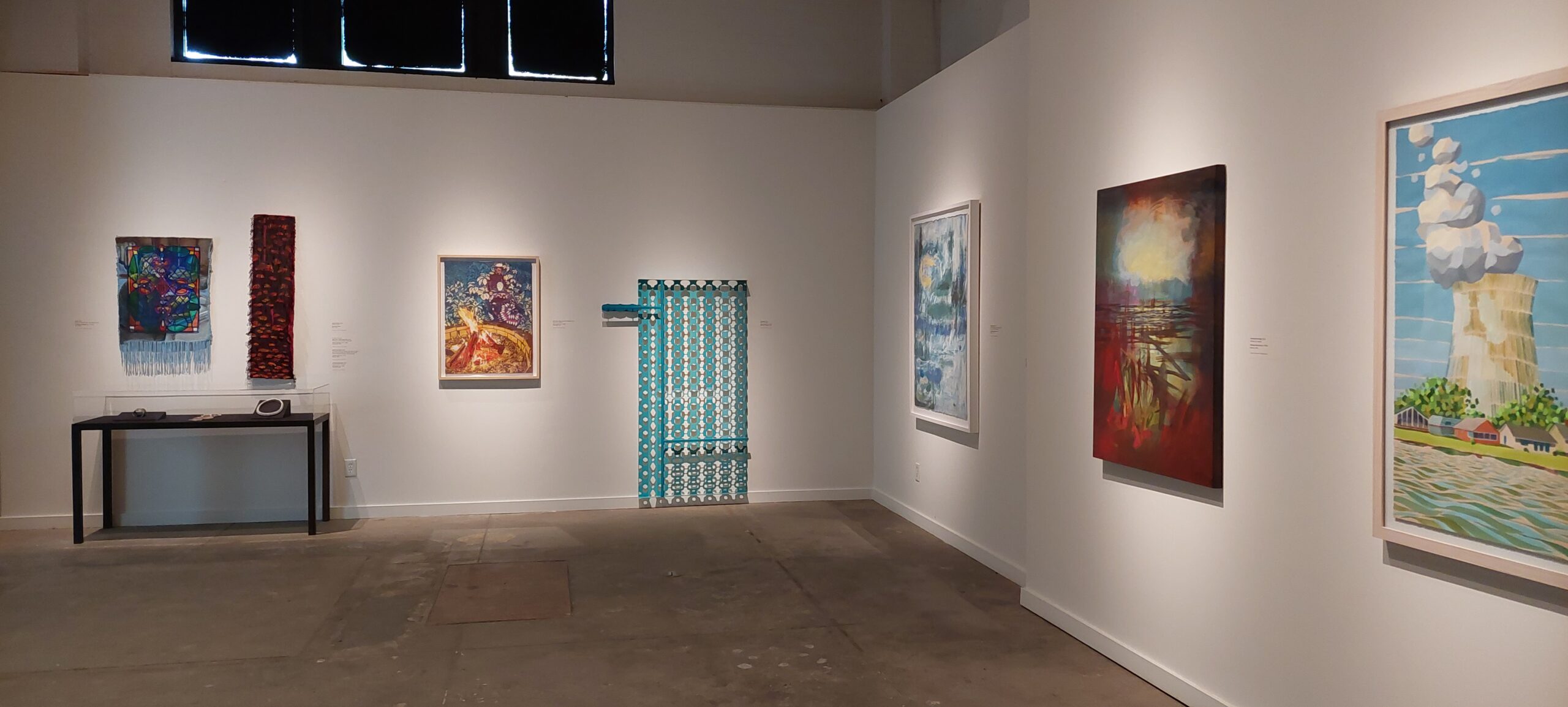
July 30, while on vacation overseas without a computer, I received on my phone, from the Cleveland Museum of Art, a list of corrections and clarifications to Henry Adams’ review of Lake Effect: Artists from Cleveland Now, on view at Transformer Station July 9 – December 6, 2026 . The re-edited version of the review below was completed on my return, and includes corrections. Those corrections, including some names, deletions and additional information, are marked with [X]. In addition, the full list of notes from the Museum appears after the review, as does a response from Henry Adams.
— Michael Gill, Editor
It’s well worth going to see the Lake Effect: Artists from Cleveland Now at the Transformer Station. But doing so also provides a stimulus to do some serious thinking about the challenges of supporting local art and creating a dynamic community of local artists that are raised by the project.
Providing recognition to living artists from Cleveland and the surrounding area is an institutional mission in which the Cleveland Museum of Art has badly fallen short. Lake Effect is surely an attempt to fill this gap, but in my view it not very successful in doing so. Indeed, it’s not altogether clear whether it’s a celebration of Cleveland art or another exercise in artistic apartheid—an attempt to keep living artists at arm’s length. The very title of the show is a bit ambiguous, for “Lake Effect” is a term used to describe a dump of cold wet snow that’s a big nuisance.
Let’s start with the well-established fact that Increasingly it’s become apparent that art and art-making bring many benefits to a community—including benefits that are measurable in cold economic terms. Encouraging creativity attracted productive, creative people to a place. But let’s also note that the art produced in a community has always fit awkwardly into rich art museums’ missions to acquire masterpieces. Nowhere has this tension been more evident than in Cleveland, where Sherman Lee–whose twenty-five year directorship from 1958 to 1983 largely shaped the character and operating procedures of the Cleveland Museum of Art– took pride in the fact that he turned up his nose at art created in Cleveland, as something provincial and mediocre, and unworthy of his attention. He focused on what he regarded as world-class masterpieces from just about everywhere else.
From a treasure-hunting standpoint this approach made a certain degree of sense, but it wasn’t good for Cleveland as a city. Surely it’s not entirely an accident that in the years of Sherman Lee’s tenure Cleveland slipped from a major center of both art making and innovation in business, to a rust-belt city, a place where rivers caught fire, a place known to outsiders as “the mistake on the Lake.”
Having pointed out the dangers of disregarding it, I think it should be clear that on the whole I’m a supporter of local and popular art. But that said, to support local art, a museum has to confront some challenging issues. Not least is the fact that there’s just too much art being produced for art museums to show it all, and not all of it is very interesting to look at.
To be honest, I personally vacillate between being a snob and a populist. Clearly it’s important for an art museum to display and preserve the masterpieces of the ages, the landmarks of civilization. But surely it’s also important to encourage emerging artists, including those who have not yet fully mastered their skills. How can one reconcile these two agendas?
The current exhibition, Lake Effect, at the Transformer Station, has many positive features, and shows that the Cleveland Museum of Art is starting to face these issues. But it also shows that the Museum hasn’t figured out how to do so.
A bit of background puts the Lake Effect show in perspective. When the Transformer Station was created in 2013 by Fred and Laura Bidwell, it’s clearly stated goal was to bring Cleveland out of its provincial isolation and teach Clevelanders to appreciate cutting edge contemporary art. Bidwell was vigorously opposed to an approach which nurtured art from the ground up, and for example was 100% against having the Cleveland Museum bring back the May Show, which in the 1920s, 1930s and 1940s focused on the art of the Northeast Ohio region, and in that period was the best attended exhibition every year at the Cleveland Museum.
As an extension of this “cutting edge” agenda at the Transformer Station, at truly staggering expense—about 15 million dollars—the Bidwells staged an art extravaganza known as the FRONT Triennial, which scattered conceptually challenging art all over the city. The result might politely be described as a boondoggle. The art was hard to find, and the audience was miniscule. Certainly the project brought no significant boost to the reputations of the artists who showed in it, whether local artists or those brought in from outside. In February 2024 FRONT cancelled its planned 2025 summer exhibition and went out of existence. And in February 2023 –earlier than planned–the Bidwells handed over Transformer Station fully to the Cleveland Museum of Art.
Big institutions make a practice of trying to hide their mistakes, but clearly what had once looked like a big financial boost had become a liability, a White Elephant, a financial drain, and one with no clear mission. It was clearly time to make a U-turn. In recent years, the Cleveland Museum’s neglect of regional art has also increasingly become a matter of controversy, a sore point that the museum needed to deal with. The space provided by the Transformer Station clearly provided a way of making a token effort to cover this lapse, to show art that might be less than the highest level of quality, without sullying the high standards of the museum itself. (In the last two years, a series of exhibitions featuring artists of the region has served as Transformer Station’s programming, including a collaboration with Cleveland Institute of Art students, faculty and alumni, the Museum’s own Staff Show, and an exhibition organized by the Cleveland Print Room.) Lake Effect continues that practice.
What’s fascinating about Lake Effect is that it’s completely a U-turn from the initial, “cutting edge” agenda of the Transformer Station. It is clearly a response to entirely different financial and social concerns.
Unfortunately, there are many signs that the project was undertaken out of duty rather than passion. While billed as a “juried show,” the modest handout for the exhibition doesn’t indicate who the jury was. You’d need to hunt around on the internet to discover that it was Nadiah Rivera Fellah, the Museum’s [X] Curator of Contemporary Art, who for whatever reason clearly preferred to remain anonymous.
The art world is filled with petty jealousies, cliques and rivalries. My guess is that getting involved in a show of this sort is a detriment to a curator eager to win over the big money world of billionaire collectors and internationally focused art dealers, as well as that of pretentious critics and academics and readers of Art Forum. To gather the work, the museum issued an open call to Cuyahoga and surrounding counties—the same footprint as the May show. Nine hundred fifty artists responded, submitting 1700 works, of which 66 were chosen. [X] Although artists statements are not printed on the labels, both the intro panel and rack cards invite visitors to “…learn more about the artists and their work in Lake Effect…” via the Web Gallery | Lake Effect: Artists from Cleveland Now. By following those links, visitors can read statements from the artists, along with biographical information and links to personal websites. [X] The project is simply a gathering of physical stuff, carried out in a conceptual vacuum.
The publicity materials for the show indicate that it was chosen by “a jury,” but it’s not stated how the objects they chose from were screened. For example, Jenniffer Omaitz is represented by a big abstract painting but my impression is that her best work is her sculpture of collapsed and collapsing structures. Why was this painting chosen? While artists’ statement can sometime be painful to read, it would have been nice to have allowed the artists to make some sort of statement about their goals and the technical procedures they followed, which often exploited new media in a creative, inventive way.
It’s usual to devote much of a review to a discussion of the quality of the works in an exhibition. But there 66 works in the exhibition by as many different artists. There’s not more than one work by anyone. To do justice to all the artists who have done good work would result in a list not much more interesting than a shopping list. That said, let me try to convey some feeling of what’s on view.
On the whole what’s evident is that the sort of art currently on view at the Transformer Station is exactly the opposite of the modern art on view at the museum itself. There’s only one large abstract painting on view, the one by Jennifer Omaitz already mentioned, which is perhaps a bit reminiscent of Al Held. The other pieces that play with abstract themes, such as [X] Shawn Powell’s [X] Pink and Green Spiral on a Green Background is definitely tongue-in-cheek: a pink and green garden hose over a background of grass that’s coiled so as to resemble a geometric abstraction. There are a few smaller abstract works.
There’s a lot of what might be termed “vernacular realism” which turns an observant eye and somewhat cynical eye on the world around us. Sometimes there’s a touch of social commentary, as in Timothy Callaghan’s view of a nuclear reactor towering over the cheerful little houses of a suburban neighborhood, [X] Avery Duff’s [X] view of Wasteland/Wetland, 2025, which portrays a greenhouse half underwater, and can be interpreted as a statement about climate change and global warming. But a lot of what’s shown isn’t pushing a political agenda but is simply encouraging us to look at the complexity of the world around us, as with the streetscape by [X] Nicole Maye Luga, titled Turning Back, [X] with its accumulation of closely observed cars, houses, and street signs, or the absurdity of our social rituals, as in Toby Griffith’s satirical rendering of a gallery opening, The New Collectors, or [X[ Donna Coleman’s [X] technically remarkable tempera painting, [X] The War on Halloween, [X] which has a touch of the grim view of human folly that we find in the work of Hieronymus Bosch. Maxmillian Peralta’s Air Mattress, which portrays an air mattress in an otherwise empty apartment, with a view out on an industrial landscape, surely touches on issues of existential alienation in our impersonal high-tech world.

Often it would be nice to know a bit more about how the paintings were made, and whether they relied on photography or direct observation. For example, I know that Frank Oriti often makes photographs for reference when carrying out portrait commissions, but his In These Boots looks to me as though it was directly painted from life, and is a painting where the sheer application of paint has an emotionally intense quality that’s difficult to communicate in words. Often it would have been helpful to have had a bit more explanation of how the work was made as with Janice Lessman-Moss’s remarkable [X] 514, Diamonds in the Sky I, [X] which combines silk, wool, aluminum wire, handwoven on a digital jacquard loom. Clearly her technique is an intriguing mix of modern high-tech with ancient craft techniques. It would be nice to have a bit of explanation.
What I take away for the show is that there are a remarkable number of very gifted artists in Cleveland, but that the museum has not yet figured out a way to support what they’re doing. While a step in the right direction, “Lake Effect” is only a small step. In many regards it’s both visually unsatisfying and intellectually feeble. And it’s striking that it’s being staged at a considerable distance from the main building of the Cleveland Museum of Art, whose galleries of contemporary art are also visually unsatisfying, though in an almost completely opposite way. There’s an element of Orwellian “double-think” to the way both ventures are being advertised, without indicating the tensions between them. It would be nice if both agendas had a bit more passion and sincerity at their core. And it would be nice if they harmonized with each other.
Notes from the Cleveland Museum of Art:
- Nadiah’s title is wrong: Nadiah Rivera Fellah, Curator of Contemporary Art (not associate)
- He says there’s no intro panel, when there is indeed one in the entry way, which explains the show (maybe he missed it)
- Amy Buff should be Avery Duff (also he got the title of the work wrong as written by the artist) The artwork in the show: Wasteland/Wetland, 2025. Avery Duff (b. 1992).
- Jennifer Omaitz’s name is spelled wrong (its Jenniffer)
- Sean Pacelli is not the artist of Pink and Green Sprial, its Shawn Powell
- The New Halloween is not a work in the show, I think he’s referring to a painting titled The War on Halloween, and the artist’s name is Donna Coleman (not Donna Coburn as he writes)
- Katy Richard is the not the artist of the streetscape he describes, I think he means Nicole Maye Luga’s Turning Back
- The submission / screening guidelines are not mysterious, they are publicly available on this website: https://lakeeffect-artists-fromclevelandnow.artcall.org/
- The title used for Janice Lessman-Moss’s work also does not match (the full/correct title is #514, Diamonds in the Sky I)
- Although artists statements are not printed on the labels both the intro panel and rack cards invite visitors to “…learn more about the artists and their work in Lake Effect…” via the Web Gallery | Lake Effect: Artists from Cleveland Now. Anyone who does so will be able to read statements from the artists, along with biographical information and links to personal websites (depending on what the artist chose to write/include)
- Please note the author’s former affiliation with the museum.
Henry Adams, a regular contributor to CAN Journal who is also Ruth Coulter Heede Professor of Art History at Case Western Reserve University, author of some 300 scholarly and popular articles and 14 books or book-length exhibition catalogs, was also a curator at the Cleveland Museum of Art from 1997 to 2002. In 1999 he curated an exhibition of the work of Viktor Schreckengost which was the first major exhibition of the work of a single living Cleveland artist ever staged at the museum.
Henry Adams’ responds:
I’d like to thank [The Cleveland Museum of Art] for drawing attention to one of my most extraordinary artistic gifts, which is to spell the same word in several different ways, often in the same paragraph. Not everyone appreciates this gift and my apologies to those among the very talented artists in the Lake Effect show who aren’t pleased with the highly creative ways in which I’ve spelled their names.
I should note that it’s not easy these days to figure out who is a curator of what at the Cleveland Museum of Art or how to contact them. Many of the links that come up first when you search on google contain information that’s incorrect and out of date.
In addition, “Lake Effect” is surely an instance in which finding a clear explanation of what it’s about is like playing a game of hide-and-seek. No doubt there are statements about the show that are posted here and there, but they are not in one place and they are often quite cleverly hidden.
You must be logged in to post a comment.