
A Clearing: Word, Image, Body, at Zygote Press

There is a clearing inside a nondescript brick building on the corner of Perkins Avenue and East 40th Street in downtown Cleveland. It is not a grassy clearing that you might find in nature surrounded by trees, but a metaphorical “clearing” in the gallery space of Zygote Press. The exhibition, A Clearing: Word, Image, Body, takes “inspiration from the notion of a clearing—a space for the practice of liberation,”[1] as acclaimed author and Ohio-native Toni Morrison (1931-2019) conceptualized in her 1987 novel Beloved, and participates in Literary Cleveland’s year-long celebration of Morrison’s life and legacy.[2] Co-curated by Anthony Huffman (who is also a CAN Journal Writing Fellow) and Scout Bach, A Clearing explores how art might also function as a figurative clearing by encouraging viewers to consider “different possibilities for selfhood, relation, and collective life.”[3] The exhibition features prints and mixed-media creations by Ohio artists Benjamin Smith, Marcus Morris, Euzhan Shabazz, solo, and Tatyana Atkinson. Between two and five works by each artist are on display, encouraging visitors to devote more focus to each work, sit with the ideas each artist intends to convey, and immerse themselves in the “clearing.”
Zygote Press’s gallery space lends itself to the concept of a “clearing.” The exhibition unfolds in the atrium-like space at the center of the building, greeting visitors upon entry. The second-floor balcony provides a bird’s eye view of the installation below, where two record players invite visitors to select a vinyl recording and listen closely. Smith provided the players for his series “Black Classical,” which asks, “how a community might compose and transmit its own cultural life?”[4] The East Cleveland-based artist, musician and community practitioner[5] recorded interviews of fellow residents when asking them a deceptively simple question: “What brings you joy?”[6] He encoded these recordings on small vinyl records (Black Classical, Volume 1, 2026; Black Classical: Transmissions 1 and 2: What Brings You Joy?, 2026) to evoke music—hence the “Classical” in the name of the piece. A small, red pouf prompts visitors to sit down during the listening experience. The tactile aspect of this work reminds us of the physical nature of an archive, asking us to consider what might constitute such an archive and how it must be maintained. Moreover, Smith’s question, “What brings you joy?” connects the viewer to the exhibition’s central notion of a “clearing.” Smith’s archive documents the joy and the cadence of his interviewees, which, in turn, sets the tone for visitors’ engagement with the rest of the art in the gallery.
On the other side of the Smith’s record player, visitors face a burnt doorway, with the knob and lock almost peeling off the wood. Similarly charred window frames line the walls. The artist placed a photograph of each of his interviewees in middle of the darkened wood frames. He prompts visitors to directly engage with his interviewees through these images and the dialogue from the record player; it’s as if the visitor knocked on the door and conducted the interview. This act sublimates the archive and reimposes the body of the interviewee into the gallery. The visitor no longer encounters a photograph or a recording, but a human being. Instead of merely documenting joy, Smith asks the visitors to be in community with him and his interviewees, with joy as its foundation. Moreover, Smith’s simple, black guestbook (Black Classical: Ledger, 2026), located in the far corner of his section of the exhibition asks visitors to consider the question “what brings you joy?” and offered pens for them to write their responses into the pages of the ledger. Representing the culmination of Smith’s motifs in the gallery, it is a physical invitation to join a community, not only with the artist, but with other visitors in the gallery.
As visitors move around Smith’s burned doorway, they also observe multi-colored prints paired with black and white photographs decorating the walls. The prints from Silly Fruit Studio founder Shabazz (Esperanza, 2026; I Sway, 2021; Gentle Black Boy, 2023; Flowers, 2020; Tribute to Toni Morrison, 2026) feature faceless silhouettes, bright against their background, encouraging visitors to consider the interiority of her subjects and imagine themselves as the subject. Morris’s photographs (Beloved, 2023; Together In The Land, 2023; Journey to the Clearing, 2023; Entering the Clearing, 2023; The Clearing, 2023; Disappearing Acts, 2022) play with the themes of motherhood that Morrison presents in Beloved. Morris–whose work–centers Blackness, queerness and performance[7] –uses the photographs to explore the idea of “rememory”—a reconstructed, queer past that engenders a space for self-love.[8] Paired together, the prints and photographs ask the visitor to directly engage with their subjects. In a way, this is also an invitation to the “clearing” that the visitor must discover through a vivified the experience of art.
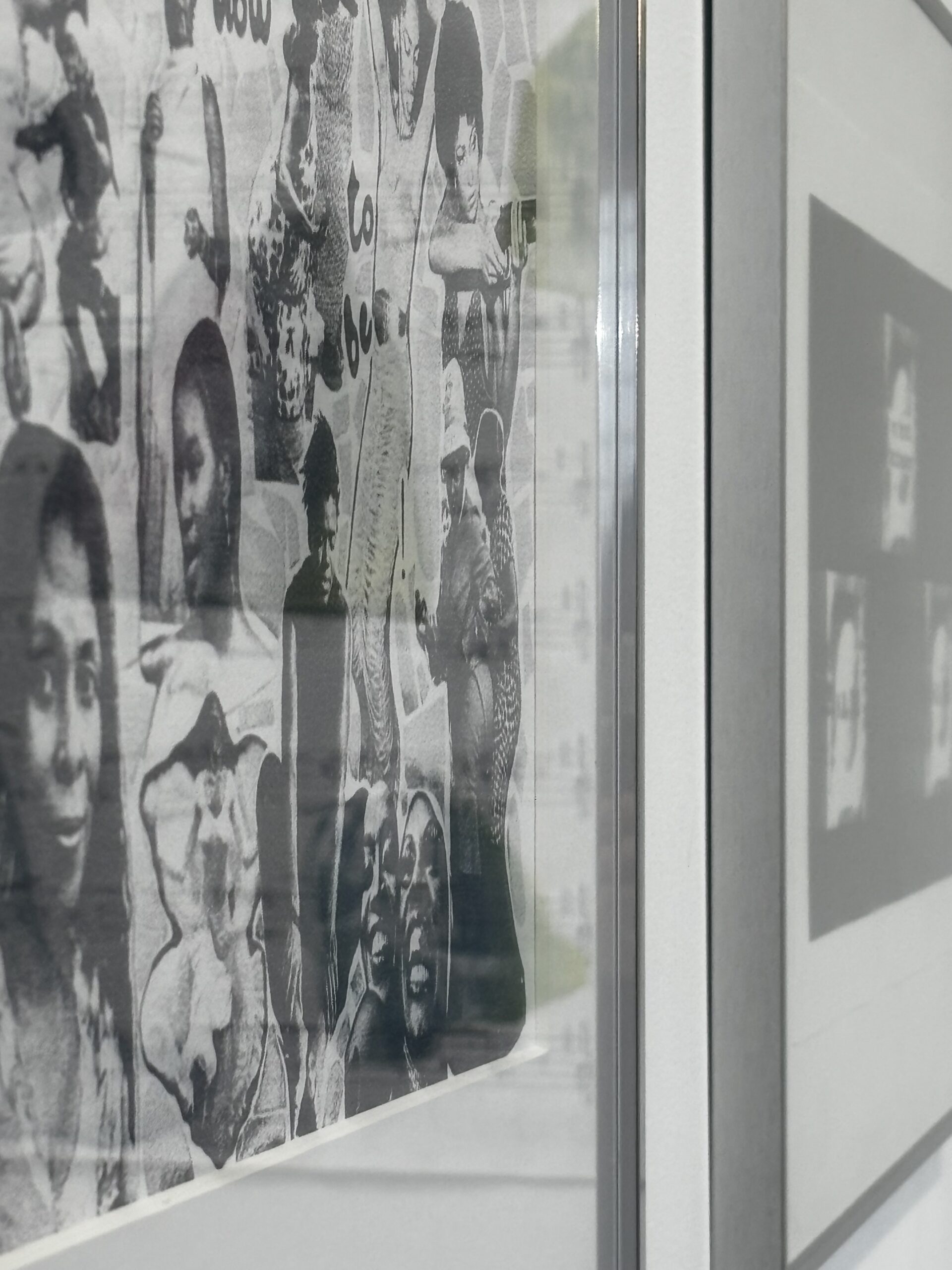
Moving further through the exhibition, visitors glimpse two prints by the mononymous artist solo. Their work, state-sanctioned (2026), featured three condoms with the words (from left to right): “H.R. 3083,” “No Fascist Factcheckers,” and “H.R. 7820.” The first condom referred to the 2025 congressional act “Consent is Key,”[9] and the third referred to the “Abortion Care Awareness Act,”[10] introduced in 2024. Neither bill made it past the House committees. Their other piece. i/own free [self-titled] (2026), depicts a collage of black women and the words “don’t tell me how to be” in cursive. Both pieces demonstrate resistance against the state’s policing of the body. Their role in the clearing, then, is to remind visitors that while such constraints exist outside the space, the clearing itself demonstrates the possibility of an alternative way of life, in which the body is liberated from the state.

Turning to the right, visitors encounter three works by Atkinson, a multidisciplinary artist who approaches making as an act of reclamation.[11] The first work is beside the entrance to the printing studio, while two larger works hang on the wall separating the gallery from the lounge. The first of her three displays near the entrance to the printing studio, Quiet Storm (2026), superimpose the artist’s great-aunt’s divorce papers, verse, and the photographic cutouts of a woman embracing a man with his face scratched off against a background of a musical score. Another collage, Ain’t But Seven Sticks (2026), uses six repeated cutouts and a central portrait, all depicting the artist, to evoke a tarot card. The seven of wands, as denoted by the title of the work, portend defensiveness and effort needed to continue maintaining success.[12] Movin’ on Up (2026), comprises woodcuts of Georgia, South Carolina, North Carolina, Washington D.C., and Ohio, on which the artist laser-etched each state with her family’s story, mapping the topography of her ancestry. Displayed together, these three works form an archive of Atkinson’s heritage.
On the right, a brightly colored stained-glass window catches light. A church fan hangs on either side, each printed with a pair of hands clapping in prayer. Directly below, a coffin rests on plinth, inscribed with the words, “I’ve wasted so much time not showing you grace,” at the center, and a quote from Morrison’s Beloved outlining the edges: “She told them that the only grace they could have was the grace they could imagine. That if they could not see it, they would not have it.”[13] Who did the Body (2026) subtly reminds the visitor of a chapel or a place of contemplation. The art subsequently questions whose body is in the coffin? Is it yours? And if it’s yours, have you given yourself grace? Paired with Morrison’s quote, Atkinson posits that to create a clearing, the visitor must imagine it first and connect the act of liberation with self-love and healing.
Another of Atkinson’s works, a triptych, features two birds in conversation. One sits on a fence and the other flies in the air. The artist inscribes bits of dialogue onto the frame: In the first frame, a bird chirps, “Sorry,” while in the third, a bird sings, “I love you.” In the middle frame, Atkinson includes a poem that she composed. The birds are meant to represent herself and her grandfather who died recently of Alzheimer’s disease. The birds also evoke Morrison’s Song of Solomon, in which the main character’s ancestor escapes slavery by taking flight.[14] The piece highlights Atkinson’s motifs about ancestral history as well as release from suffering. It reinforces the tone of the exhibition as a “clearing” which becomes a space of connection to loved ones in addition to liberation.
The selection of the artists and their works by Charisse Harris, Quartez Harris, and Zachary Thomas, as well as Huffman and Bach’s curatorial vision cohesively achieve the exhibition’s goal of literally carving out a clearing, in terms of “place and practice.”[15] Each work lends itself to the larger themes by encouraging visitors to contemplate ideas of liberation and self-love and consider how these ideas form a community. Even the labels, though small and difficult to read at times, integrate with the exhibition to reference Zygote Press as the space—the actual clearing—behind the gallery. Together, the organization of the space flows with each reference of community, allowing visitors to feel the gravitational pull towards the “clearing.” After taking a turn through the space, visitors can expect to leave Zygote Press with a new idea of liberation: that this feeling is something we can potentially find not just in ourselves, but also with each other. And, maybe, we can enact this feeling by creating our own “clearings.”
A Clearing: Word, Image, Body
September 10 – October 30, 2026
Artist Talk with solo, Tatyana Atkinson, and Euzhan Shabazz and curators Scout Bach and Tony Huffman: 5:30 – 7:30 pm Friday, October 30
Zygote Press
3907 Perkins Ave.
Cleveland, OH 44114
Citations:
Congress.gov. “H.R.7820 – 118th Congress (2023-2024): Abortion Care Awareness Act of 2024.” March 29, 2024. https://www.congress.gov/bill/118th-congress/house-bill/7820.
Congress.gov. “H.R.3083 – 119th Congress (2025-2026): Consent is Key Act.” April 29, 2025. https://www.congress.gov/bill/119th-congress/house-bill/3083.
Creatives Now. “Black Classical: What Composition Emerges When a City Listens to Itself?” Ear to the Ground, August 12, 2026. https://www.eartotheground.art/post/black-classical-what-composition-emerges-when-a-city-listens-to-itself.
Gong, Tina. “Seven of Wands Meaning – Tarot Card Meanings.” Labyrinthos, March 6. https://labyrinthos.co/blogs/tarot-card-meanings-list/seven-of-wands-meaning-tarot-card-meanings.
Marcus Morris. “Bio.” Accessed September 14, 2026. https://www.marcus-morris.com/about.
Morrison, Toni. Beloved. Alfred A. Knopf, 1987.
Ohio Celebrates Toni Morrison. “Exhibition Opening Reception for “A Clearing: Word, Image, Body.”” Accessed September 14, 2026. https://ohiocelebratestonimorrison.org/event/exhibition-opening-reception-for-a-clearing-word-image-body/.
Silly Fruit Studio. “About.” Accessed September 14, 2026. https://sillyfruitstudio.com/about.
Solo. “About Solo!” Accessed September 14, 2026. https://theesoloartist.com/aboutsoloooooooo/.
Zygote Press. “About Us.” Accessed September 14, 2026. https://zygotepress.org/about-us.
Zygote Press. “Benjamin Smith.” Instagram, August 15, 2026. https://www.instagram.com/p/DcEDXFYjOZq/.
Zygote Press. “Current Exhibitions.” Accessed September 14, 2026. https://zygotepress.org/exhibitions.
Zygote Press. “Euzhan Shabazz.” Instagram, August 14, 2026. https://www.instagram.com/p/DcBengpD3ax/.
Zygote Press. “Marcus Morris.” Instagram, August 7, 2026. https://www.instagram.com/p/DbvdADtjqnw/.
Zygote Press. “solo.” Instagram, August 6, 2026. https://www.instagram.com/p/Dbs4NPPleYj/.
Zygote Press. “Tatyana Atkinson.” Instagram, August 8, 2026. https://www.instagram.com/p/DbyB1LkFuR8/.
[1] “A Clearing: Word, Image, Body,” Current Exhibitions, Zygote Press. https://zygotepress.org/exhibitions.
[2] “About,” Ohio Celebrates Toni Morrison, accessed September 14, 2026. https://ohiocelebratestonimorrison.org/about/.
[3] Zygote Press, “A Clearing.”
[4] Creatives Now, “Black Classical: What Composition Emerges When a City Listens to Itself?” Ear to the Ground, August 12, 2026, https://www.eartotheground.art/post/black-classical-what-composition-emerges-when-a-city-listens-to-itself.
[5] Creatives Now, “Black Classical.”
[6] Creatives Now, “Black Classical.”
[7] “Bio,” Marcus Morris, accessed September 14, 2026, https://www.marcus-morris.com/about.
[8] Definition of “rememory” provided on the exhibition label corresponding with the photograph.
[9] “H.R.3083 – Consent is Key Act,” Congress.gov, April 29, 2025. https://www.congress.gov/bill/119th-congress/house-bill/3083.
[10] “H.R.7820 – Abortion Care Awareness Act of 2024,” Congress.gov, March 29, 2024. https://www.congress.gov/bill/118th-congress/house-bill/7820.
[11] Zygote Press (@ZygotePress), “Tatyana Atkinson,” Instagram, August 8, 2026. https://www.instagram.com/p/DbyB1LkFuR8/.
[12] Tina Gong, “Seven of Wands Meaning – Tarot Card Meanings,” Labyrinthos, March 6, https://labyrinthos.co/blogs/tarot-card-meanings-list/seven-of-wands-meaning-tarot-card-meanings.
[13] Toni Morrison, Beloved, 1987.
[14] Connection to artist’s grandfather and Song of Solomon provided on the corresponding exhibition label.
[15] Handout of curatorial overview, provided by Zygote Press at exhibition.
You must be logged in to post a comment.