
Utopia Realized—The Art and Inquiry of Michael Loderstedt

This article is about Michael Loderstedt, the artist. It omits—perhaps unfairly—the considerable body of poetry and biographical work that he has completed in the past ten years. As an artist, his work is mostly about his present and our present. As a writer, he often reflects and reports on his Huckleberry Finnesque childhood and adolescence on the Outer Banks of North Carolina. See, especially, his memoir Yellowhammer’s Cross, 2020.
Michael Loderstedt first began exhibiting in Cleveland in the mid-1980s. In the decades that followed, he became the most influential artist in Northeast Ohio. His work—charming, incisive, and revelatory—had compelling appeals and his awkward charisma and compulsive swirl of energy drew friends, colleagues, acquaintances, and patrons into its vortex. He influenced and enhanced a perception of our city and region as a quirky utopia—a place where failure of ambition was not defeat; where possibility had the capacity to soar; where how we define who we have been, who we are, and who we might be is up to us. It was a personal, embracing vision of utopia, interwoven with a personal, embracing redefinition of place.
In anticipation of an exhibition in 2012, he wrote about his work this way: “I’ve created several bodies of work which in some capacity addressed utopian endeavors, both local and international. In the mid-90s I photographed and interviewed greenhouse workers in the Rockefeller Gardens in Cleveland, and I’ve researched, photographed and written about early colonial landing sites on the eastern seaboard of the US. In these bodies of work I was genuinely interested in learning about what motivates people, and how that changes the landscape. I’ve also read their longings for activity and exploration of ‘the other’ as potent metaphors for artistic and aesthetic fulfillment.”
Without much adherence to particular discipline or media—books, sculpture, drawings, prints, photographs—everything he touched became a vehicle to peel away pretense and reveal. It is raw and sometimes has rough edges, but that is essential to art-making. As the sculptor Winifred Lutz insisted, there is no such thing as talent; there is only honesty.
Much of Michael Loderstedt’s work was directly influenced by the cultural forces that created what was called New Journalism in the 1960s and 1970s, with such notable works as Hunter Thompson’s Hells Angels, Tom Wolf’s Electric Kool-Aid Acid Test, George Plimpton’s Paper Lion, and Truman Capote’s In Cold Blood. Distinguishing from traditional journalism, new journalism emphasized the importance of the scene—that is, the context. And then the writer’s immersion within that context and their personal reaction and response. In sociology, this approach dates to the early 1900s, and came to be described as participant-observer.
Loderstedt’s work reflects that immersion. It was a break with Cleveland’s preoccupation with system-oriented art of the 1960s and 1970s (Ed Mieczkowski, Julian Stanczak, David Davis, John Pearson) and the neo-expressionism which followed in the 1980s and 1990s (Kenneth Nevadomi, Patricia Zinsmeister Parker, Douglas Max Utter).
My poetry teacher at Baldwin-Wallace College, H.D. Rowe, taught that too often aspiring writers attempt what they believed might be universal, but what results on the page was something odd and unrelatable. Instead, he suggested that if the writer was absolutely personal—both truthful and wholly self-aware—then the writer was more likely to relate what is common and important in human experience.

Michael Loderstedt has always done that. Early work from the late 1980s included a shadow box in which a photograph of the artist, fully nude, was assembled in articulation like a puppet, with pivots at the joints (elbows, knees, shoulders, hips). And then wings were attached to his back, like Icarus. A crank protruded through the Plexiglas could be turned, causing the figure to flail, as if failing and falling. Another work in that series, the God Box, had drawers with elements to be assembled, with the potential for the patron to crucify the artist. Work like this might be embarrassing, in a way, but also invited participation in artistic process. The work was not about artist as other; the work was about the artist as ourselves.
The work did not preach. It drew from experience.
In his earliest work, before his first show at William Busta Gallery, Loderstedt utilized imagery and forms that evoked ritual and signs of primitive cultures. Then, it evolved to mine the culture of his lifetime for signals, assumptions, and emblems to critique contemporary political and social structure. Developing a dialog with symbols and images, mixing and juxtaposing visual cues, he led the careful audience to confront the schisms between belief, trained perception, and observation.
Over the course of my career, some artists encouraged studio visits and others did not. I had been showing Loderstedt’s work for a number of years before I first visited his studio. Since he used all sorts of vintage elements—books, graphics, materials, small objects—I expected a cluttered studio, with stacks and shelves of stuff from which he could select, like going down a grocery aisle. Instead, I found one box in the corner, not even half full. I realized that as objects came into his studio, they were not allowed to laze around—they were drawn upon, manipulated, altered, and re-assembled and sent back into the world. That is one of the reasons that he did not invite studio visits—he brought work to the gallery, as it was finished, all the time, ready to have it find a public.

His personal was overwhelmingly compelling. A birdhouse that was modeled as a replica of the house that he owned, then was set inside a cage, also shaped like a house—as a centerpiece of an exhibition that featured animals in a zoo, and people looking at and responding to the animals.
After being stabbed on the streets of Akron, his next exhibition included dyed fabric in the arrangement of hospital curtains, presenting, as if in a shrine, the blood-stained shirt that he was wearing.
He was integral to the blossoming and maturity of a visual arts community in Cleveland during the past four decades. In the 1990s he lived in the Hodge School, an incubator for artists in an inner-city East Side neighborhood. He was an electric presence, active in his studio and engaging with other artists to present projects and exhibitions. Later, he purchased a house in the Collinwood neighborhood of Cleveland on a private street of cottages, built in the early twentieth century. The neighborhood became an art colony and magnetic center, with artists (including Ray Juaire and Patti Fields, Leslye Discont Arian, Laila Voss, Bruce Edwards, Bellamy Printz, Timothy Callahan, Lori Kella, and Wayne Draznin) engaging with each other and, perhaps most importantly, with our Great Lake.
He taught at University of Akron, Cleveland Institute of Art, College of Wooster, and Kent State University—where he eventually became an associate professor and acting director of the School of Art.
He jumped into opportunities to collaborate, with artists as diverse as Craig Lucas, Robert Beckmann, Terry Durst, and Kevin Everson. As Craig Lucas commented, in discussing a major commission (Double Atlas, painting on aluminum with cast resin and photographic inserts, 20 X 20 feet, 1997-1998.) that they created for a Progressive Insurance in Florida, “in collaboration, one discovers the ability to let go of one’s ego and gain openness to inspiration”.
With Kevin Everson (since, an artist who has exhibited in the Carnegie International, Whitney Biennial, and the Sundance Film Festival), Loderstedt created a series of extraordinary, monumental pinhole photographs, beginning by building a camera, sized to fit the entire bed of a pick-up truck. In this collaboration one artist entered the camera, unrolled the photographic paper, pinned up the paper on the back of the camera, lay down in front of the pinhole lens, and waited as the “outside” artist removed the tape blocking the lens. With resolution sharp and blurry in the same image, characteristic of pinhole photography, the images had the precision of the present and a dreamy fading into the past and future. Photographs from this series are in the collections of the Cleveland Museum of Art and the Akron Art Museum.
Collaboration was not just a way to create; it was a way to establish networks, to build vocabularies, to engage issues of place and build a meaningful intelligence—to imagine new possibilities. Where are we now? Where have we been? Where could we possibly be?
To create a suite of photographs of Lake Erie, he enticed a captain and his sailboat, gathered a crew, and affixed a radio-controlled camera with a fish-eye lens to the top of a mast of a sailboat. The art-making was not only the work that eventually hung in galleries, but also the experience of crossing the lake on a voyage of discovery to find the other side. Tales of the voyage spread exponentially, inviting into a revelatory mythic structure.
That was typical of the genius of Michael Loderstedt. He participated in everything, ever expanding his circle of engagement, finding new ways to meld the intimate and expansive, the personal and universal.
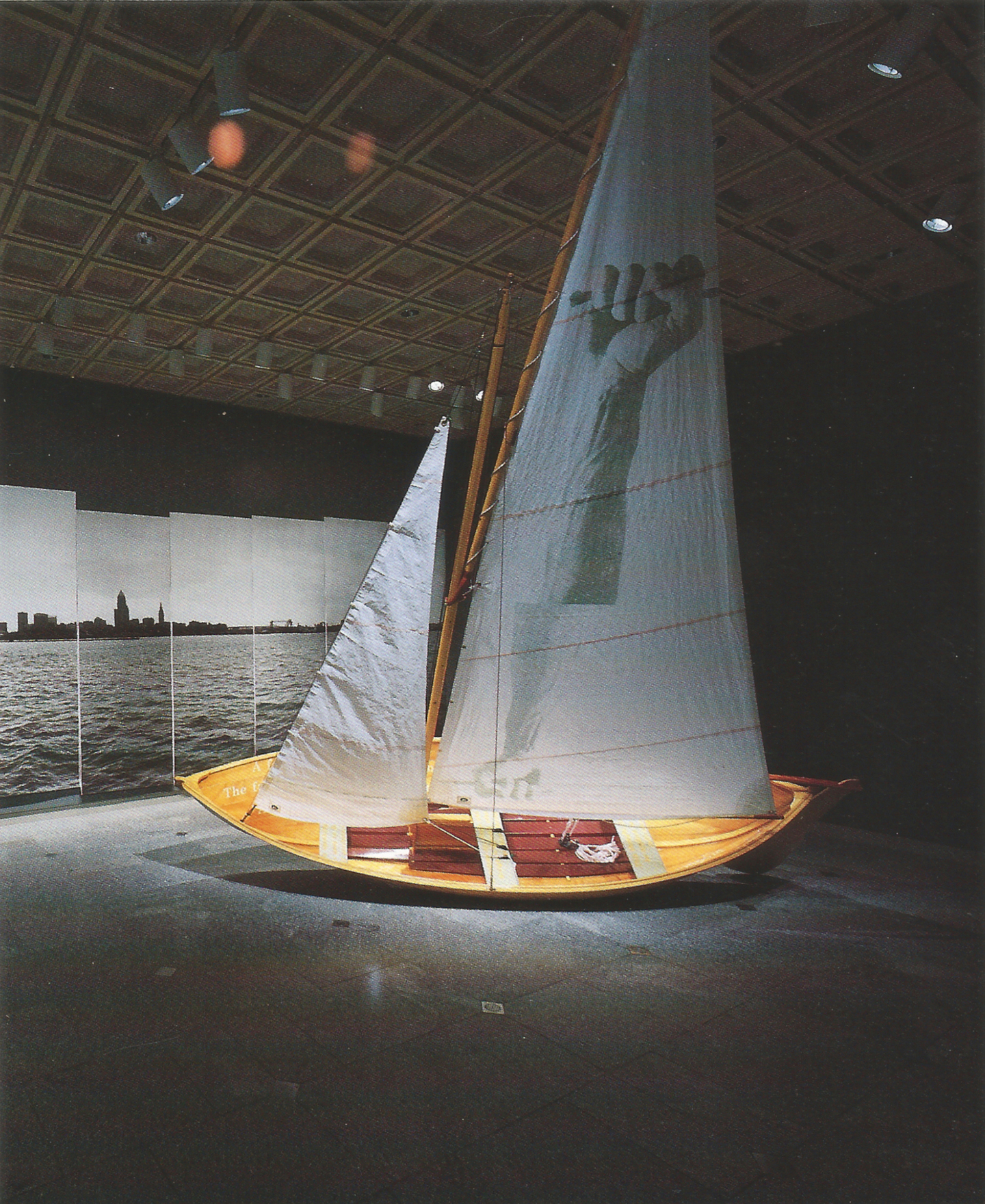
Major bodies of his work included a permanent installation at the Lakeshore branch of Cleveland Public Library that traces the history of the site from pre-settlement through its use as a farm, a school, a convent; a temporary installation at the Cleveland Museum of Art that set the form of a sailboat against the harbor of Cleveland, questioning whether the senses of “fairness” as used to describe efficient industrial form could also be applied to the social actions of individual in an industrial city; images (as varied as skulls, birds, immigrant ships, and German houses) that were drawn and printed like cut-and-assemble childhood models, which he then cut-and-assembled, bridging the disconnects between idea and object, between presentation and potential; and books, compasses and maps that followed Marco Polo to the Orient, bringing back riches, encouraging scientific inquiry, and establishing cross-continental patterns of social interaction.
The word utopia first came into use in English with a publication by that name by Thomas More in 1516. His utopia was an island with perfected and egalitarian organization. It is a Latin word, which translates into English as “nowhere.” A sly poet might add a space so that word reads “now here.”
William Busta presented one-person exhibitions of Michael Loderstedt’s work at his gallery on Murray Hill Road in 1989, 1992, 1993, 1995, 1997; at his gallery on Detroit Avenue in 2001 (with Craig Lucas); at his gallery on Prospect Avenue in 2012, 2014, and 2015; and at his gallery on Waterloo Road in 2023.
You must be logged in to post a comment.