
Riso: An Indie Publishing Revolution

You may have seen the term RISO or Risograph lately and thought to yourself, “what on Earth is that?” What was once a very niche form of printing has become the darling of the zine-making and small press publishing world, and is so mainstream that graphic designers can even purchase RISO-effect filters for Photoshop. Put simply, a RISO or Risograph machine is a Japanese stencil duplicator that uses ink instead of toner, usually printing a single color at a time. It can be used as a form of printmaking to make art prints or to make zines or books. A cross between screen printing and photocopying, the resulting prints are lush, velvety, often employing vibrant colors, heavy halftone textures, and registration misalignments. RISO is all this, but it is also so much more.
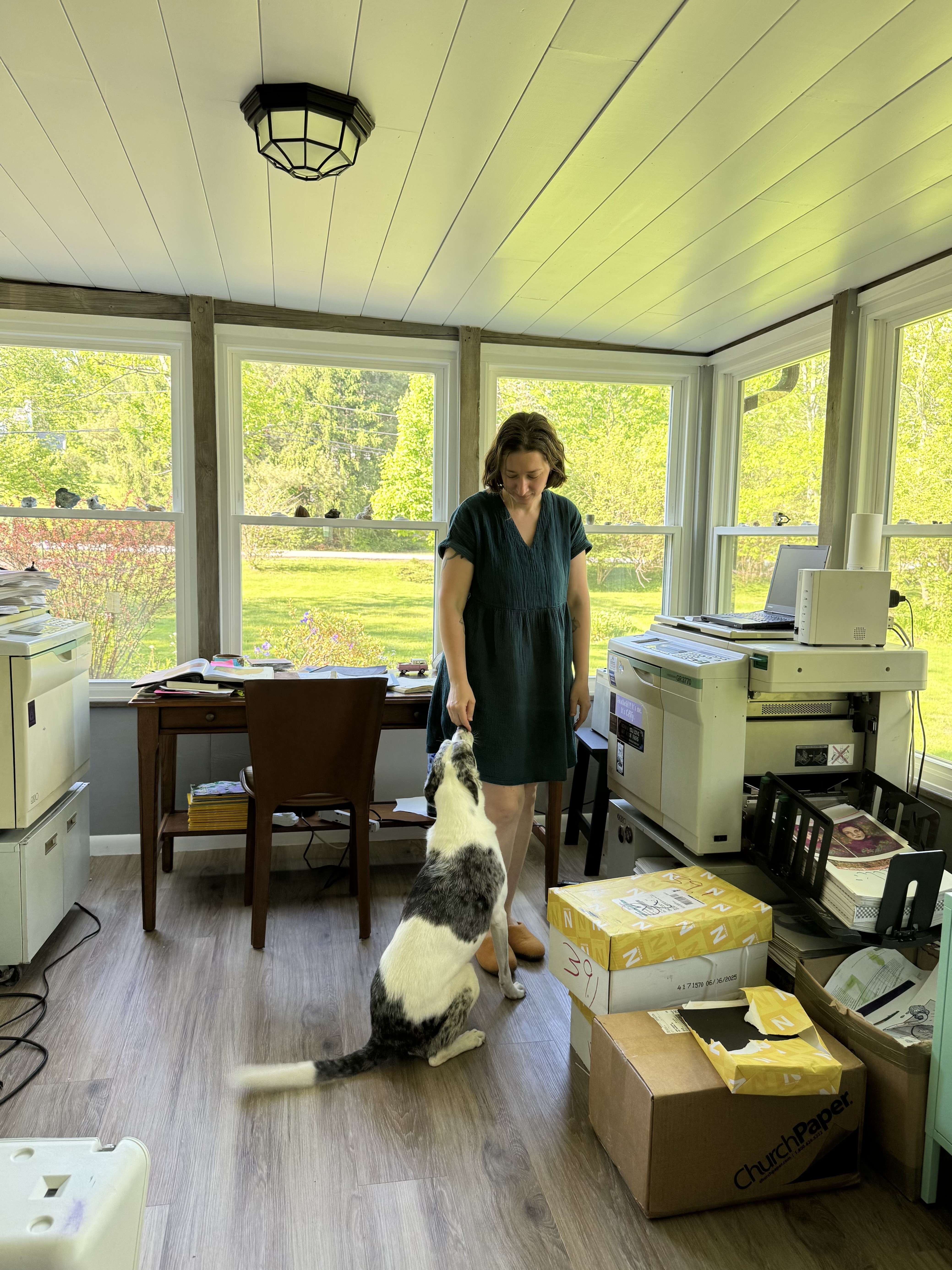
On a late spring day, Anna Tararova casually walks through her studio, Empress Editions, in beautiful Solon, Ohio. Housed in a four-season room overlooking lush trees and greenery, the stars of Tararova’s small press are two identical GR3770 RISO machines (it’s always smart to have a back-up machine). She first encountered RISO in graduate school at Ohio University in Athens. Their renowned printmaking department teaches techniques considered avant-garde, a category that RISO would fall under.
A Short Technical Description of Risography by Anna Tararova
Risograph is a brand of digital duplicators created by the Japanese RISO Kagaku Corporation. It creates highly detailed stencils and is able to produce single-color images. Some newer models are able to print two colors at once. Since the 1980s, these duplicators were marketed to educational institutions, government offices, companies and print shops all over the world as a way to cheaply produce high volumes of single-color prints.
The RISO takes a greyscale image and/or text and creates a stencil, which is wound around an ink drum. Paper is pressed against the drum to make a single-color print. To add another color, the whole process is repeated with another color drum (see infographic). Imperfect registration and a very specific color scheme make this process unique and a fun design challenge.
As these machines were being replaced with newer models, artists and designers started playing around with the outdated models, pushing the limits of single-color printing, mixing new ink colors, and learning to repair and maintain their Risos. There is now a widespread network of Riso appreciators, who are happy to share their technical knowledge and business advice, troubleshoot repairs, and share in the stress of keeping a decades old machine running.
Tararova uses her RISO machines primarily to make small press artist books. Even in the digital age, RISO is far more cost-effective for high volume printing. It is less expensive, and the prints are also technically “hand-made”. To print highly complex images, the paper sometimes has to pass through the machine several times. The ink must be layered, which means the imagery must be registered (aligned). The drums are changed out by hand when a new color is needed, and an intimate knowledge of each machine’s settings, nuances, and capabilities is necessary to be able to print and assemble an entire run for a book.
Through her imprint Empress Editions, Tararova works directly with artists to create books of incredible nuance and beauty. Far from the DIY zine spirit of many RISO productions, these books are carefully and thoughtfully printed. One of these books, Divine, is the most beautifully crafted RISO-printed product I have ever seen. Using RISO, Tararova was able to translate photographs by local artist Kenyatta Crisp into impossibly lush, tactile images on the page. Using CMYK and gold ink, it is the kind of book that has to be seen in person to truly be believed.
Tararova’s most recent project was funded by a grant from The Satellite Fund. Swamp Water is a collection of art and writing inspired by wetlands. She commissioned photographers, illustrators, environmentalists, and poets to contribute something inspired by northern Ohio’s many wetlands. But Swamp Water is more than an artist book or a science journal: it’s a love letter to the most misunderstood and vital landscapes on this planet. The book is perfectly bound, and Risograph printed in an unbelievable eleven colors.

Beyond her own small press, in Northeast Ohio Tararova is something of a Riso-whisperer. Locally, she has the most technical and practical knowledge of these tricky machines. She teaches RISO classes, and helps local RISO owners troubleshoot the inevitable problems that crop up. Like photocopiers and toner printers, RISO machines do encounter frequent technical challenges, but unlike their more prevalent younger cousins, there is not an ecosystem of repair technicians to help when you fall into trouble. One of the best things about RISO is the community of users who crowdsource their knowledge, and Tararova is an important cog in this system.
Because of the complex technical nature of Risography, many artists simply hire presses to print their work. In Cleveland you can hire Empress Editions or Specific Ideas, a private RISO studio run by Adam Swift Lewis out of the basement of his Cleveland Heights home. There’s also Clatter Press in Columbus owned by siblings Dempsey and Nigel Ewan, both graduates of Columbus College of Art & Design; and Cereal Box Studio in Cincinnati, run by Julia Warner and Eric Blyth.
While there are many RISO machines in Northeast Ohio, access is still an issue. A majority of these machines can only be found in a university setting, where access and training are limited to students. But luckily there are places in our region where you can learn the process and get public access. The Cleveland printmaking nonprofit Zygote Press acquired a RISO machine, affectionately named Lizzo, when Tararova was the shop manager. They regularly hold workshops and offer access to their community members during open studio hours for a drop-in fee.

One of the most exciting new regional spaces to learn and use RISO is down at the Bounce Innovation Hub in the historic Goodrich Building in Akron. Conceived and run by artist Micah Kraus, Ditto Riso is a RISO studio dedicated to hosting workshops and creating opportunities for artist collaboration. Thanks to an ArtsNow ArtsForward grant, Kraus was able to acquire two SF5130 RISO machines and eight colors for his community-focused RISO studio.
Once a high school art teacher, his goal for Ditto was to provide opportunities for community interaction and creative engagement through the risograph process. To that end, Kraus offers workshops—to the general public, groups, organizations—and also teaches one-on-ones to artists and designers interested in the process. Kraus’s Riso Basics workshops encourage the layman to explore the machine using simple techniques such as collage. “It’s a reminder to people that they have that creative muscle,” he said as he leafed through some of his students’ work.
Alongside his community workshops, Kraus also takes on commission work, including making RISO prints for the Canton brewery, UnHitched. His vibrant RISO prints are used by the brewery to illustrate their various beer varietals, with the trademark imperfections and half-tone of a print actually made on a RISO machine. Perhaps indicative of the increasing popularity of the medium, businesses are hiring him specifically for RISO printed materials.

Local restaurateur and James Beard Award nominee Vinnie Cimino recently approached Kraus to make RISO drink menus for his new restaurant, Rosy, on Cleveland’s West Side. Undoubtedly Cimino could have had a graphic designer use a RISO-effect filter, but employing Kraus supports a local artist and the resulting menu is hand-made with great care. In an age when ChatGPT- and AI-created slop is filling our feeds, it is heartening to see businesses turning to local artists to create their advertising and paper goods, and even requesting RISO.
RISO, despite being highly technical, is ultimately a very human medium. It is a tactile process, requiring much more than merely the mind of a designer. Like many forms of printmaking, it is physical—you have to move the heavy individual drums of color in and out of their boxes and into the machine. The paper has to be loaded—then misfeeds inevitably happen. Half of Risography is troubleshooting—reading error codes, turning knobs, trying new settings. It is hands-on in the very best way. If you’ve ever seen someone take apart a faulty RISO drum, you will understand. But don’t attempt it yourself; for that, you will need to call Anna Tararova.
To see all of the lovely publications by Empress Editions, and many other small presses that use RISO, visit the Cleveland Art Book Fair at 78th Street Studios from noon to 6 pm on Saturday, October 24. Admission is free!
Risograph Resources in Northeast Ohio
Local RISO small presses:
Empress Editions: empresseditions.press
Specific Ideas: specificideas.com
Learn RISO:
zygotepress.org
Ditto Riso: instagram.com/dittoriso
Local RISO artists of note:
Scout Bach: scoutbach.com
April Bleakney: apebleakney.com
Zoe Brester-Pennings: zoebp.xyz/art
Leo Covault: lrcovault.company.site
Kim Lavery: instagram.com/kimperly
You must be logged in to post a comment.