
Hedge Gallery Presents: I Am An Old Woman Playlist + A Library of Selves

HEDGE Gallery presents a dual exhibition featuring intersecting bodies of work that explore the power and complexity of aging via the voices of woman artists who are living their truths unapologetically and out loud. I Am An Old Woman Playlist features print media collages by Liz Maugans, while A Library of Selves features drawings, paintings, and silk tapestries by Rebecca Cross. Installed side by side, the media, personalities, and aesthetics differ. Yet together, through their work, we hear the united voices of women everywhere defying the rules of aging through expressions of love, humor, and grief in a society that often does not allow that.

Liz Maugans: The Playlist as a Diary
To Liz Maugans, a Cleveland-based artist who received her BFA in printmaking from Kent State University and her MFA from Cranbrook Academy of Art, I Am An Old Woman Playlist is both a declaration and a disruption of the societal norms of a woman in midlife. The exhibition celebrates the resilience, complexity, and authority of the middle-aged woman, forcing them to be seen when they are made to feel invisible. She states that “through collage, text, and image, [she] explore[s] the emotional dualities of aging: exhaustion and clarity, grief and possibility, loss and reinvention. This work does not romanticize growing older but reclaims it as a space that is generative, honest, and radically expressive.” Maugans achieves this through multi-media collages named after favorite, emotionally charged songs by women she continues to listen to and is inspired by, including Stevie Nicks, Tina Turner, Edie Brickell, Nora Jones, and Olivia Newton John, with a few inspirations from men such as Bruce Springsteen and the Beatles thrown in.

Admittedly, my undying love for Stevie Nicks and penchant for book clubs drew me to Landslide Book Club, 2026, a print and media collage featuring a mound of colorful readers, some adhered to the paper and others dangling freely, inviting viewers to pluck them from the surface. The inclusion of library book pockets, with paper scraps bearing the titles of some of my favorite books such Jane Eyre and Wuthering Heights poking out, made my heart swell for both the nostalgia of remembering the library cards in the backs of books during childhood and the emotions evoked by the various novels themselves. At the top, the text “READ ’EM AND WEEP” perhaps nods both to the inevitable tears stirred by Nicks’s “Landslide” and to the all-too-familiar frustration of reaching for a pair of glasses to read a single thing at a certain age. Maugans traced the readers from her mother’s eyeglasses–seven pairs, to be exact–which she found after she passed. The work is combination of the artist’s personal resistance to using readers and an homage to her mother’s love of reading and viewing the world through words. Though her failing vision can be frustrating, Maugans sees it as something of a silver lining. She is learning to look less intensely at everything and instead see through the blurry tenderness of what truly matters. Like the lyrics of Landslide suggest, the artist is becoming emboldened by time while still navigating the changing seasons of her life.
Maugans continues to explore her personal experiences with motherhood in her vibrant work Mother Ship: Come Away With Me (Norah Jones) To Liv, JB and Will, another print media collage featuring an array of sailboats. The work is as much a love letter to her upbringing on Lake Erie, where she enjoyed watching sailboats on a tumultuous lake, as it is to her children dedicated in the title of the work. With age and time, she now sees the boats as a metaphor for the mothership that carries, protects, guides, and somehow keeps going through life’s hardships she’s watched her peers endure, such as illness, grief, divorce, and job loss. “And still”, she states, “somehow, someway, my fellow wayfarers find a hospitable, lucky-break current, beyond that riptide shit storm, and do whatever it takes to float their boat.” Sometimes we are the ship. Sometimes we are the storm. And sometimes, we simply need someone like Nora Jones to say, “Come away with me. For a little while.”

I’d be remiss not to mention how I audibly cackled upon encountering Bare Necked Ladies, For Nora, 2026, a print collage dedicated to another Nora who also has a way with words. I immediately recollected the sharp wit and humor in Nora Ephron’s 2026 memoir I Feel Bad About My Neck, to which the work–featuring about 50 women’s headshots with wrapped necks–undoubtably referred. The women who posed for the piece were treated to a print of the work at the exhibition, an offering I found endearing (and was jealous not to be a part of). In her memoir, Ephron, like Maugans in I Am An Old Woman Playlist, captures the humor, frustrations, and indignities of getting older through satire and irony. As Ephron famously wrote, “Our faces are lies and our necks are the truth. You have to cut open a redwood tree to see how old it is, but you wouldn’t have to if it had a neck.” Maugans’s work in the current exhibition at HEDGE Gallery offers a similarly playful yet poignant exploration of the middle-aged woman’s experience, using women we all admire as her muses.

Rebecca Cross: Self-Portraits and Silk Lightscapes
Rebecca Cross, another local graduate of Kent State University as well as Oberlin College, is an accomplished textile-based artist who takes a bold and vulnerable turn in A Library of Selves, where she explores her newfound passion for painting self-portraits. She embraces her self-proclaimed lack of skills in this medium and leans into the playful side of this artform, exploring form, color, line and texture as new means of representation. In this exhibition, by continually drawing and painting her face, Cross enjoyed the process of seeing herself as a work of art and embraced her imperfections and quirks without judgement. As she continued to express her “many selves” through portraiture, she grew to love this new body of work that represents the different versions of ourselves we all carry within us.
The resulting body of portraits, which Cross first called The Furies and later Goddesses, captures a range of her mental and emotional states through a series of fifteen casein and graphite drawings on paper. With apt titles such as Goddess of Discernment, Goddess of Wrath, Goddess of the Wizening Face, and Goddess of the Imagination these powerful self-portraits question whether it’s a radical notion for a woman to simply paint her true self, showing her age and wisdom for all to see, in an era where the society-described ideal of beauty is youthfulness. Of this, Cross states: “Surely we are far too captivated by youth as an ideal that we want to fix (in both senses) by all manner of preventions and treatments. Yet I agree that aging, as my mother used to say, is not for the faint of heart. Painting self-portraits in my 60s is one way to move past this cultural nonsense, and assert that self-portraiture can be the presentation of emotional, physical, and psychological states.”

Cross’s works in this vein are less traditional self-portraits than they are embodiments of the goddesses she prays to, the goddesses carried through the ghosts of her ancestors, and the goddesses she discovers within herself, brought forth through the act of naming each work. Formally, Cross describes the portraits as explorations of new materials and, perhaps more importantly, of the inherent challenges of self-portraiture. She claims that some have criticized the works for not looking like her or for appearing unresolved: the graphite shows through the bright planes of colors and appears to be unfinished for not having been colored in. Cross embraces both observations, suggesting that likeness and resolution may not be the point. Instead, these works reflect how we are continually transformed by a lifetime of encounters with joy, loss, love, and the accumulating experiences that shape who we become. Exploring this new terrain has been both a challenge and a pleasure for Cross, as she develops a visual vocabulary that continues to reveal new compositional possibilities.
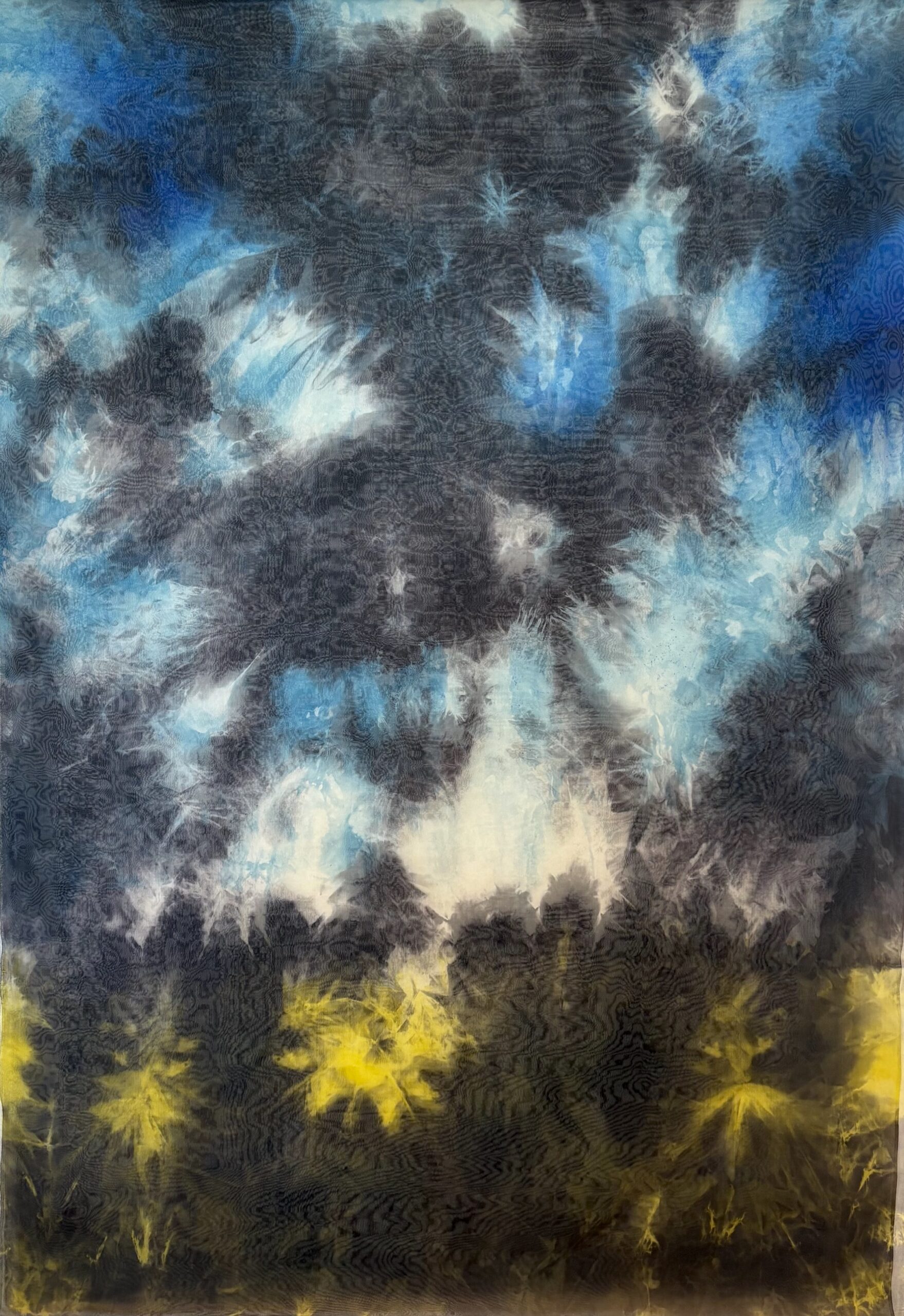
An exhibition of Cross’s work would not be complete without showcasing her silk colorfield lightscapes, which suggest horizons and the reflection of light through the translucency of silk fabric. To achieve this, Cross employs the traditional techniques of Japanese shibori, a shape and color resist immersion dye process. The resulting tapestries evoke subtle reflections of an ethereal landscape swathed in colors not typically found in nature. In Are the Stars Out Tonight, a prominent anchor of the exhibition, luminous purples and deep indigos evoke what Cross describes as the wonder and intricacy of the natural world that informs her work. In Flashing Storm, the midnight blues and deep yellows suggest a storm unfolding over Lake Erie, reflecting Cross’s fascination with the lake’s ever-changing moods and atmosphere. Lake Erie serves as a muse for Cross as well as Maugans, connecting their work through a shared experience of the water on the horizon where they’ve called home.
Cross suggests that the lightscapes complement her self-portrait paintings in the exhibition: “some are roughly the size of my own height and wingspan, providing serene “bodies” or contexts for all those painted heads.”. Certainly, she feels, they resonate with the” scale, energy and concerns” of the works in the exhibition by Maugans, which mirror self-reflection in aging.
Seen together, I Am An Old Woman Playlist and A Library of Selves offer a provocative meditation on the experience of women aging in our society, expressed through song lyrics, graphite-rendered wrinkles, beloved novels, and quiet silk serenities. By integrating materials such as screenprinting, monoprinting, paint, and hand-dyed textiles, the two artists create a rich visual vocabulary for exploring what remains as life’s great loves, losses, and griefs accumulate. Together, their work becomes a generative and deeply honest testament to the resilience, complexity, and enduring power of the female spirit.
Liz Maugans: I Am An Old Woman Playlist
Rebecca Cross: A Library of Selves
August 19 – September 25, 2026
HEDGE Gallery
1300 West 78th Street, Suite 200,
Cleveland, Ohio
You must be logged in to post a comment.