
From Stroke to Brush Strokes: The Amazing Life of Artist Mary K. Thomas
Almost thirty years ago, Mary K. Thomas was in the fight of her life. She suffered a massive stroke followed by a ruptured brain aneurysm. It bled for two days. When she woke up three weeks later, she could no longer read or speak very well, and she had memory damage.
That, in her words, left her with two things: her art ability and her faith. “It was very simple for me to be able to rebuild myself using the art skills that were already inside of me to help heal myself.”
She went back to school to regain her ability to read and comprehend the written language, adding, “it was so impactful for me to be able to have art as a buffer also, um, to help lessen the pressures of studies and me trying to get back into math and science in a written way.”
She also had to recover physically, having lost strength in her hands that limited her ability to express herself as a ceramicist and painter.
In eight years of recovery, Thomas managed to excel academically, citing her faith that led to another miracle. “He [God] took the test. He took the algebra test ‘cause I had never even done algebra before. I got right into college.”

She decided she was too old to be in school without being on the Dean’s List. An associate’s degree with a focus on art therapy at Tri-C came in 2009, followed by a BA in Art, Summa Cum Laude, from Ursuline College, in 2013.
“As a small child, I studied ceramics at Karamu, so I just brought it forward. It was a big help for me to get my hands, the skill back.”
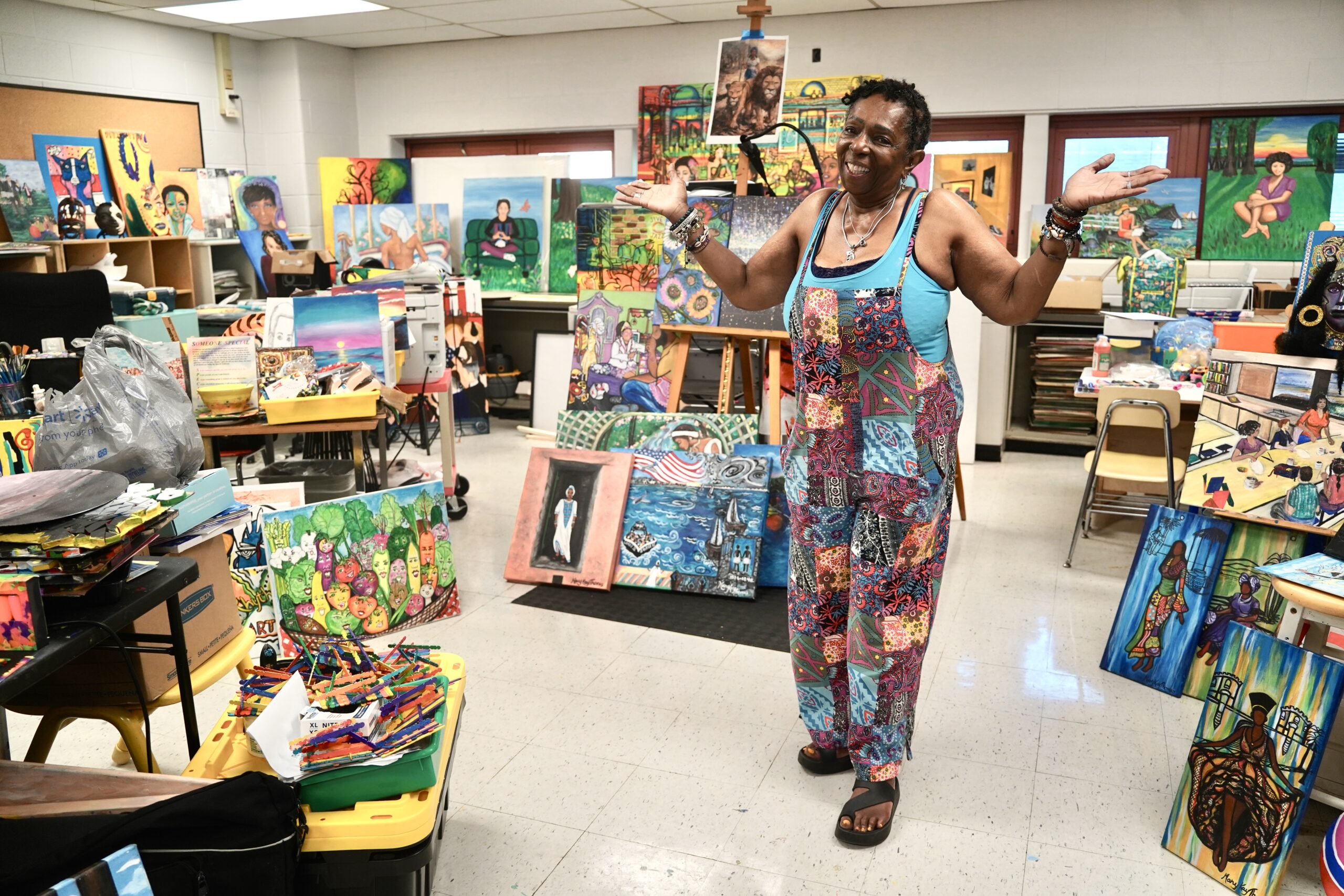
Most of her ceramic works have been sold, with the exception of a few masks on display in her studio. It’s a bright, color-filled space in the former Chambers Elementary School in East Cleveland. The building has been repurposed as the Chambers Community Empowerment Center (CCEC), the transformation and technology hub of the East Cleveland City Schools.
Following her recovery and academic achievement, Thomas ended up plying her skills in the Cleveland Heights school district, first as a lead instructor in the department of early childhood development. She also became a program writer for the district and worked in it for sixteen years. Her decision to come to East Cleveland was borne out of her observation of the difference between North Taylor and South Taylor roads as she made her journey down the hill from Cleveland Heights.
“The faces of the community were totally opposite. The thing I think that drew me the hardest was watching the men walking on Euclid Avenue. They seemed to be like a vaporous mist of what a man, a person should be and it bothered me to see our men like that. From sixteen to sixty, they were begging on the street corner.”
She wondered what she could do as an individual and artist to make an impact. Thomas arrived at using public art to make a difference. While volunteering at the Coit Road Farmers Market, she was instrumental in getting its first grant for public art, to bring color and attention to the market. Many residents were unaware of its existence.
Eventually, she landed at CCEC where she carved out a space for residents that met two key aspects of her mission: place-keeping and place-making.
“You want to find a way to thrive. If this is a tiny space for them to be able to do that and take it home and then let it fill them from day to day, that’s a good thing.”
From one to one hundred, people from East Cleveland and the surrounding area partake in the energy generated by her presence. Her nonprofit, Rhythmic Art Studio, bustles with vibrant colorful artwork, mostly hers. Masks and sculptures are in the collection, along with pieces created by others in her art world.

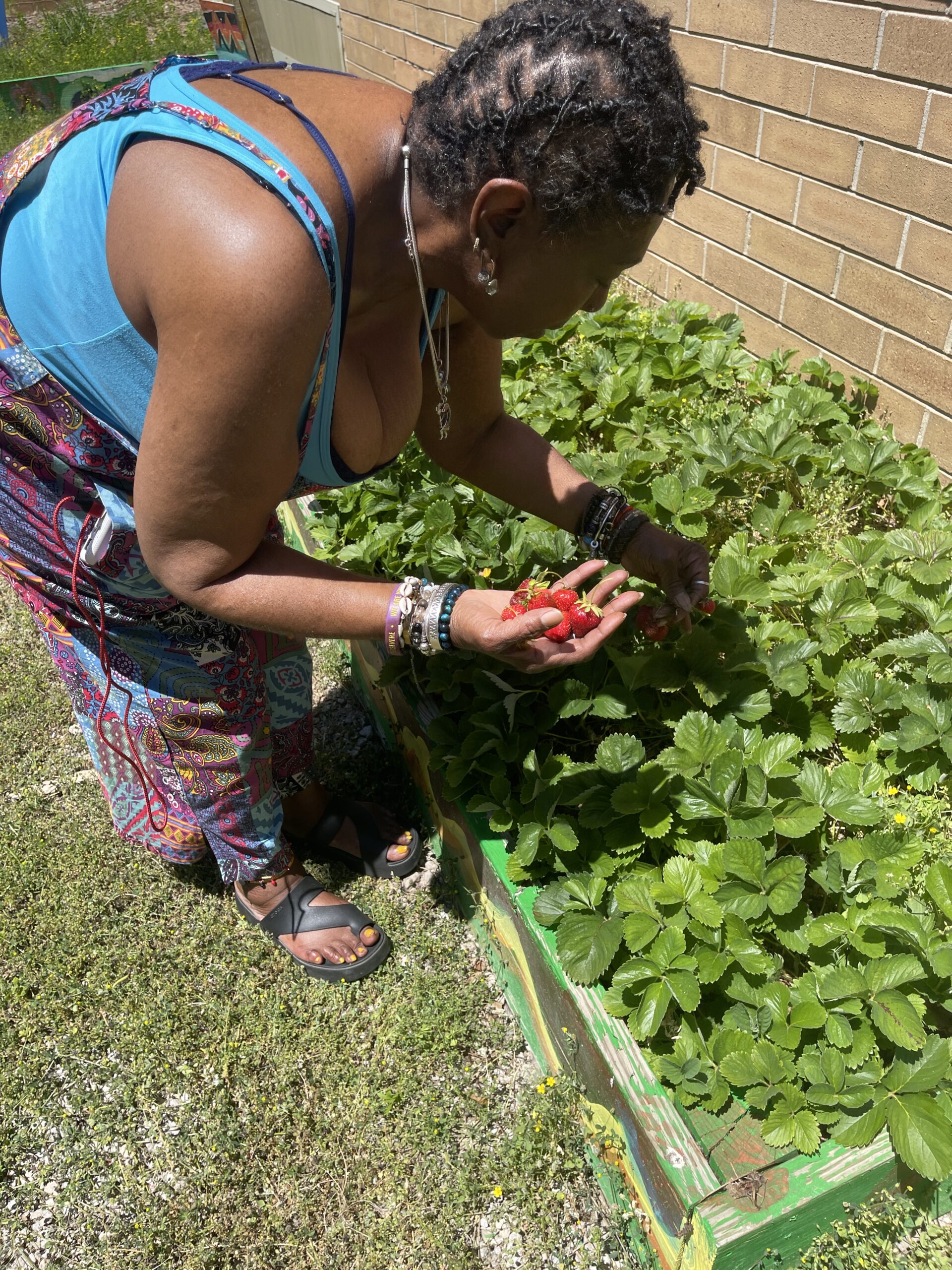
Outside of the studio on the grounds of the center is a community garden for David’s Challenge Young Achievers where she grows fruits, vegetables, flora and herbs with the assistance of children in her program. Her stepfather, Furman Anthony, left her with her a great knowledge of plants and how to grow them.
The art in the garden is augmented by children’s artwork lining the walls of the center atrium of this uniquely imagined structure on Shaw Avenue in East Cleveland.
The intersection of art and agriculture is directly connected to her ancestors. Her grandmother, Kathryn Slaughter Wherry, was an artist and musician. Her great-grandmother, Kathryn Dudley Beaumont, born in the 1890s, had a community-based outreach center. The family’s involvement in the arts is documented in her great-great-grandmother’s slave narratives in the Library of Congress.
“Yeah, we were slaves, but we were able to use our art as a way to help us survive through slavery. That goes back until the 1700s.”
Among her works is an unfinished landscape depicting the sea, the sun, and the horizon.
As Thomas described her original inspiration for the piece, her eyes welled up with tears. ” I wanted to know what it was like to step off the shores of Africa and never see it again and go to a foreign place. What that would be like.”
She found out by going to Gorée Island (Senegal) and The Gambia in West Africa and returning to create another work of art to tell the story omitted from the unfinished work still sitting in her space. It was a transformative experience.
“I’d actually been there and stood in the place where the ancestors stood, and felt some, a teeny bit, of a whisper of what they must have been feeling to know they would never see their homes for their loved ones again, ever, and going into the hands of monsters.”
Thomas finished the painting in three days. She painted a self-portrait that appears in that piece with a narrative she gleefully explained.
Her art has served as a balm in the midst of tragedy. On August 29, 2024, her eighteen-year-old grandson, Christian Tyson Thomas, was murdered by unnamed Cleveland Heights police officers. According to published reports, they were called to the residence in response to a report of domestic violence. A Cuyahoga County grand jury declined to indict the officers involved.
It’s a painful subject, stinging with the irony of her creating works of art to acknowledge the mothers of Trayvon Martin, Tamir Rice, Mike Brown and others. She never imagined that she would join the pantheon of mothers affected by police conduct. Her struggle brings her back to the very thing that saved her life and impacts those who experience what she delivers from generations that came before her.
Art has been her salvation. From the abundant paintings that fill her studio, the sculptures formed with copper wire, the clay she adeptly fashions with hands that once lost their ability to mold effectively, and plants she cultivates from seed to flower, stem, fruit and vegetable, she embraces her role as a creator/activist.
As Thomas navigates the loss of her beloved grandson, she immerses herself in the very therapy she studied to provide relief for many navigating their own traumas and circumstances, continuing the legacy of those who came before her. Their art, community focus, and ability to grow plants and cultivate creators live on through her.
The City of East Cleveland, even in the midst of receivership and civic distress, is a better place because of her and an indomitable spirit that decided that an artist could make a difference.
It can. And she does.
You must be logged in to post a comment.