
Arts for Justice Cleveland: Justice as a Mission

It’s been an exciting and transitional year for Karen Prasser. Following the closing of Chagrin Arts at the beginning of 2026, where Prasser served as Executive Director, she had to shift her focus. Her immediate priority was to relocate a symbolic sculpture, Dean Gillispie’s Imaginal Cell, which was originally installed at the Garden of Hope in Chagrin Falls. It now has a new home, at Cleveland State University’s College of Law and the Terry Gilbert Wrongful Conviction Clinic. A ceremonial ribbon cutting will take place on October 7, 2026, at 5:30pm. This new location and partnership helped inspire Karen Prasser’s mission at a new organization she founded–Arts for Justice Cleveland. The mission: to create positive social change through the arts, bring meaningful arts programming to the community, enrich lives, and create opportunities for conversation around important social issues.
Imaginal Cell features forty-four butterflies, each engraved with the name of an exonerated Ohioan and the number of years they spent behind bars for crimes they did not commit. Each fall, the names of newly exonerated Ohioans will be added. It’s a powerful symbol of transformation, resilience, and the possibility of a new beginning after injustice.
Sculptor Dean Gillispie himself is an exoneree who spent twenty years of his life in prison from 1991-2011 for crimes he did not commit. With the help of the Ohio Innocence Project, he was exonerated by the State of Ohio in 2017. But during those years in a cell, he spent hours creating art, working specifically on dioramas made with contraband and found objects. In his freedom, he continued his artistic pursuits and became a featured artist at the Museum of Modern Art. His works have appeared in the New York Times, The Atlantic, and other publications. He is now a member of the Board of Advisors of the Ohio Innocence Project, a tireless advocate to end wrongful conviction, and an ally to every innocent man and woman who was imprisoned.
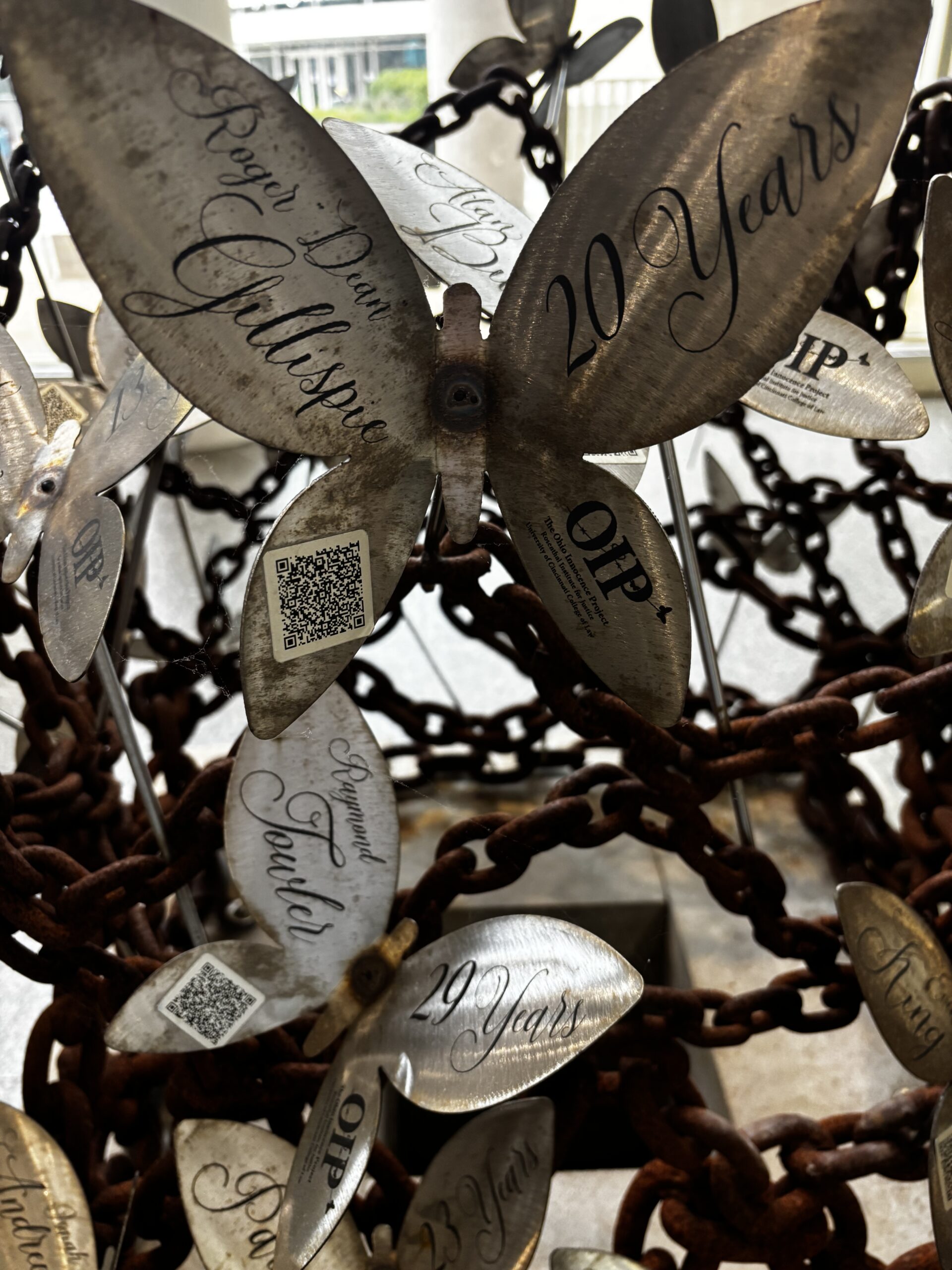
For Prasser, the relocation of Imaginal Cell represents far more than simply moving a sculpture from one site to another. It marks a meaningful transition in her own work and a new chapter in an ongoing and storied career—including the launch of Arts for Justice Cleveland, newly established in the MidTown Collaboration Center. Inspired by the partnership with the Terry Gilbert Wrongful Conviction Clinic, Arts for Justice Cleveland seeks to harness the power of art and justice to educate, challenge conventional thinking, inspire community engagement, and ultimately help reverse, transform, and eradicate wrongful convictions in Ohio. The partnership will bring together artists, advocates, legal professionals, and the community through a range of programming, including art exhibitions, facilitated conversations, and music. It will use the arts as a vehicle for community engagement on issues that touch community members’ lives and serve its stated mission.
Arts for Justice Cleveland held its inaugural event on April 30, 2026, featuring John Brown: The Dulcimer Diaries, a musical performance by artist Craig Matis based on the book by Treva Offutt. The organization currently has on view Judy Takács’s exhibition We The People…All The People, inspiring hope and action through portraiture. It’s up through election day. Using art as her ammunition and depicting our country’s most vulnerable citizens, Takács issues a call-to-action that presents democracy as a work in progress.
Next on the Arts for Justice Cleveland roster, opening November 12, 2026 at MidTown Collaboration Center, is Raymond Towler’s Art with Purpose. Towler, an exoneree who spent more than 29 years behind bars for crimes he did not commit, discovered the transformative power of painting following his release, with support from the Ohio Innocence Project. Towler also has a butterfly on Gillispie’s Imaginal Cell sculpture. The exhibitions, all curated by Arts for Justice Art Gallery Director Megan Alves, all have one clear mission embedded in the organization’s name: JUSTICE.
Prasser believes that the arts have a deep, positive, and healing impact that enhances quality of life for individuals and their communities. That belief informs her passion and her career. Prasser, who is also a professional pianist at Kent State University, was instrumental in bringing Blind Justice to Cleveland in 2025, which is an opera based on the true stories of six Ohioans who were wrongfully convicted and later exonerated through the work of the Ohio Innocence Project. With music by Scott Davenport Richards and a libretto by David Cote, the opera combines jazz, rock, hip-hop, blues and gospel to tell these powerful stories. The opera was originally commissioned and premiered by Cincinnati Opera in 2019 to five sold-out audiences. It is the proudest milestone in her career.
After Prasser’s transition from Chagrin Arts to Arts for Justice Cleveland, a close friend asked her, “Aren’t you glad you lasted long enough to get here?” Prasser was grateful to answer and astounding, “YES.” Her response speaks to the perseverance required to build a life and career in the arts. It is demanding work—requiring passion, persistence, and an unwavering commitment. For Prasser, this new chapter is a testament to that perseverance and to the belief that sometimes, lasting long enough is what allows the next chapter to begin.
Arts for Justice CLE
Midtown Collaboration Center
6539 Euclid Avenue, Suite 110
Cleveland, OH 44102
Artsforjusticecle.org
kprasser@artsforjusticecle.org
You must be logged in to post a comment.