
Amy Casey’s small worlds
It’s been no less than 20 years since Amy Casey’s last solo exhibition in Cleveland (2006, at Zygote Press.) And it’s been 12 years since she most recently shared the spotlight with just one other artist—Cathie Bleck—in a two person show at Maria Neil Art Project (2014). However, this fall, Maria Neil has ended the draught and welcomed her back with small worlds – an intimate show which, if sales are any indication, is making a big impact on the artist’s her adopted hometown audience. Casey’s small, intricately detailed paintings resurrect beloved Cleveland neighborhood landmarks that have disappeared from the landscape, evoking a powerful nostalgia for places and a time gone by. Fueled by the city around her, through small worlds she creates her own version of “there’s no place like home”. It’s on view September 4 through November 6, 2026.
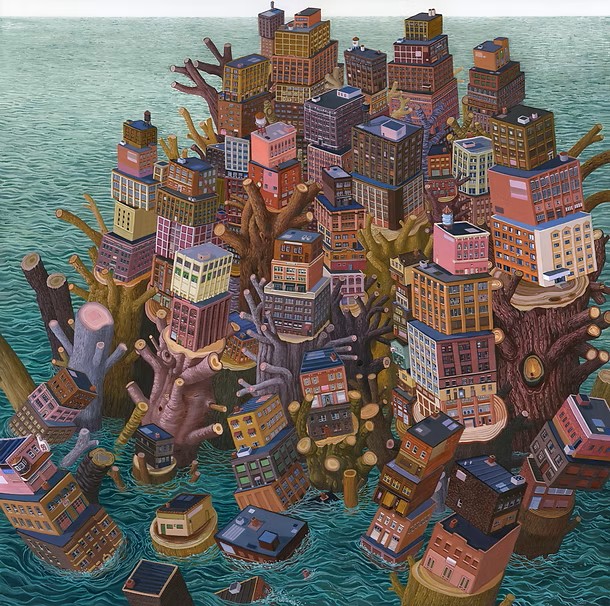
While she hasn’t had recent one- or two-person shows in Cleveland itself, Casey’s career as a full time artist has been thriving, nationally and internationally. Her work has been featured at the Crystal Bridges Museum of American Art (Arkansas), the Elmhurst Art Museum (Illinois), and the Moss Arts Center (Virginia), as well as galleries in New York, Portland, Anchorage, and Finland, and especially Zg Gallery in Chicago. While not exactly in Cleveland, she has had solo exhibitions that brought her close–one at the Butler Institute of American Art in Youngstown (2024) and the other at the Canton Museum of Art (2022), both resulting from CAN Triennial Exhibition Prizes. Recent awards include first place for realism in the Paul and Norma Tikkanen competition at Ashtabula Arts Center (2023) and an Ohio Arts Council Individual Excellence award (2019). Her work has also reached audiences beyond traditional gallery spaces, including a commissioned poster for New York City’s MTA and the inclusion of her painting High Ground on the cover of Crystal Bridges Museum’s State of the Art exhibition catalog in 2020. Throughout, Casey has continued to develop her distinctive imagined landscapes with intricately painted architecture cradled and enveloped by nature, establishing a broader audience while remaining connected to the city she calls home.
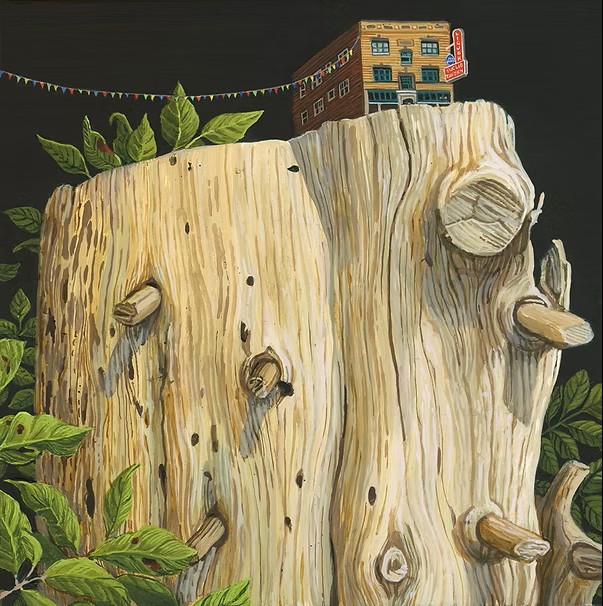
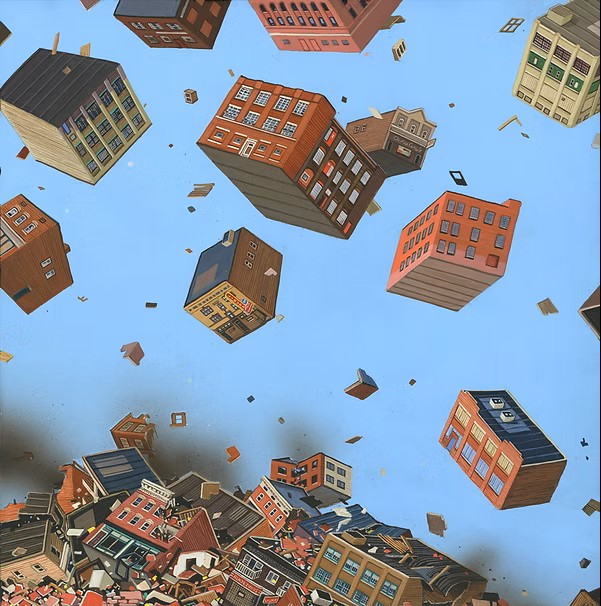
small worlds draws inspiration from Casey’s nature walks, a way of escaping what she describes as the “existential dread” brought on by the relentless news of the world. Her main body of work consists of real buildings she photographs around her Tremont neighborhood toppling, exploding, and meeting their destruction, as seen in paintings like Debris and Rendezvous. These works arouse feelings of chaos, a nod to the ever-changing climate and the shifting world around us, which simultaneously cause the artist anxiety and feed her inspiration. The work in this newer series, however, offers a more hopeful and whimsical outcome. In these small paintings, the buildings escape their inevitable doom, landing instead in fantastical, lush green forests pulsing with life where they are given a new purpose and a chance to begin anew. In my favorite piece, Take Comfort, we see the artist’s “crooked little blue house” surrounded by enormous tree-like mushrooms, as if the home blew away and landed in a Lorax landscape. In Thirsty we see the old Euclid Tavern teetering on a tree stump with a colorful pennant flag banner streaming off to a world unknown. Taken out of their context, the buildings are seen afresh as wonders of architecture taken for granted in our everyday environment.

The introduction of nature back into her urbanscapes was inspired by Casey’s residencies immersed in the outdoors, including the Arteles Creative Center in Finland where the dense and lush-green forest began just a few steps from the residency doors. Here, the artists had their modern technological comforts taken from them and were forced to contemplate in nature. Without phones and computers for distraction, they let their minds wander freely in the environments around them–an experience that can be both liberating and unsettling. This seems to have had a profound effect on Casey, who shifted the focus of her work. The two worlds of collapsing cityscape catastrophes the calming natural scenes collide into these hybrid landscapes seen in small worlds. Says Casey, “Though ostensibly charming, these landscapes are not gnome or fairy houses in a magical forest. They are the surviving remnants of a world on the precipice. But they are nothing if not resilient – like nature – and hopefully like us.”

While the 6 x 6 inch panels (which make up the majority show) may be small, their emotional impact is anything but. Looking at her painting Fungal Flats, when I spotted the beloved but long-gone music venue Pats in the Flats, which was in Casey’s Tremont neighborhood, I was immediately transported to my own post-college days, listening to music, longing for that carefree time that only exists in our memories. Both the venue and the feeling it evoked are gone. Still, because the artist and I are around the same age, I found myself imagining a world in which we might have stood under the same roof, listening to the same music, and I felt a sense of joy and connection—an effect I believe the artist intended. Through this series of resurrected haunts, such as Steve’s Lunch and the Old Fashion Hot Dog (Inn) seen in Relish and Cricket Tavern seen in Resting Place, the artist invites the viewers to recall their own memories of these vanished Cleveland landmarks. She connects with her local audience through a shared nostalgia in the ghosts of the buildings and the moments they once held. At any rate, the artist says, she gives the buildings a happy sendoff and a chance at a new alternate life in these alternate landscapes. Through art and memory, they became immortal.
The exhibition also offers a bin of limited-edition color etchings, which Casey makes at Zygote Press. They also feature her trademark architectural and landscape elements, though the etching medium brings them an interesting new aesthetic. In the etchings Mycophile and Shroom Porch, for example, bold black outlines encase the elements against stark cream backgrounds, creating the illusion that the forms are floating. Created in editions of 25 and 50, the etchings have a modest price point and an impact similar to the acrylic works. As a seasoned works-on-paper specialist, print enthusiast, and newly minted member of The Print Club of Cleveland, dare I say these speak to me more.
In her statement, Casey says: “My work contemplates the interesting times in which we live – climate change and change in general, and our ability to adapt to that or not. I hope that in looking at my work, people consider the role of community and our need for each other in difficult times. I dream that my work both gives people a space to acknowledge uncomfortable feelings about world events and also to think about how things could be different, and that it’s not too late to change. If history holds a series of catastrophes, then it must also have a series of recoveries. Perhaps the less explod-y parts of my work offer some hope that life continues on – maybe not the way we planned – but continues nonetheless.”
To Casey, the paintings in this show meditate on the feeling of being small, alone, and overwhelmed by unsettling change. For me, however, with a cheeky nod to the Disney anthem that may have inspired the exhibition’s title, Casey’s small worlds reminds us of the universal laughter, tears, hopes, and fears that connect us all. Even amid the chaos, a sense of hope shines through. In these small and intimate landscapes with relics recognizable to her hometown audience, our shared memories within the buildings connect us. As her statement suggests, Casey also celebrates a sense of community and togetherness for Clevelanders, making our very big, big world feel small.
Amy Casey’s small worlds is supported by The Creative Impact Fund, administered by Assembly for the Arts and funded by Cuyahoga Arts & Culture.
Amy Casey: small worlds
September 4 – November 6, 2026
Maria Neil Art Project
15517 Waterloo Road, Suite 1B
Cleveland, Ohio 44110
You must be logged in to post a comment.